Jakub M. Pawelczak

I am an Assistant Professor of Economics at Universidad del Pacífico, Lima, Peru. My research focuses on macroeconomics, with a particular interest in housing markets, intermediation, and spatial economics. I hold a Ph.D. from the University of Minnesota.

jm.pawelczak@up.edu.pe

Portrait of Jakub M. Pawelczak

Research

Flipping Houses in a Decentralized Market

Jakub M. Pawelczak

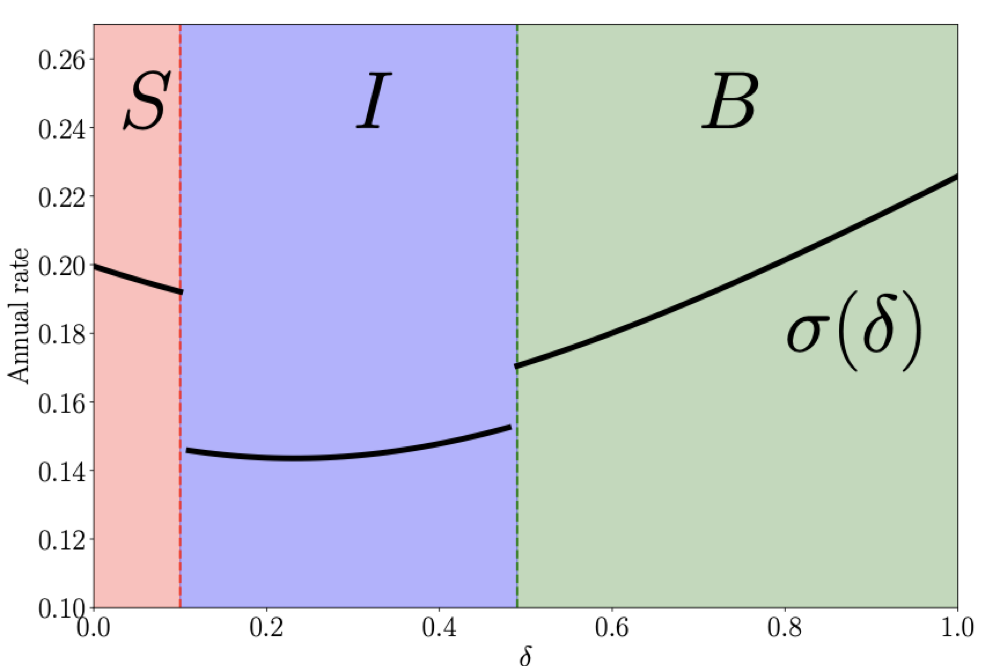
Abstract. How does intermediation in the housing market affect an economy's house price distribution, trade volume, and welfare? I study flipping houses — the fast buying and reselling of houses, which has become more prevalent in recent years. While more flipping increases market thickness, it also involves intermediaries holding housing assets instead of households. To answer which effect dominates for welfare, I develop a decentralized trade model with intermediaries featuring two-sided heterogeneity in inventory and housing asset valuation, where households trade houses with each other or with flippers. Search is random, information is asymmetric, and household valuations evolve stochastically. Using a universe of administrative transaction data from Ireland, I document a steady increase in house prices, trade volume, and flipped transactions between 2012 and 2022 — in particular, the number of flipped transactions doubled. Through a calibrated model, an increase in the mass of flippers leads to a 1.5% decrease in average house prices, implying the increase in house prices in the data was not caused by flippers but by the decrease in mortgage rates. Household welfare falls on average by 0.2%, chiefly by decreasing the steady-state fraction of households owning a home; on the positive side, misallocation of housing due to search frictions decreases.
Evaluating Universal Government Programs: A Structural Approach with Machine Learning

An Application to Child Benefits and Female Labor Supply in Poland

with Filip Premik

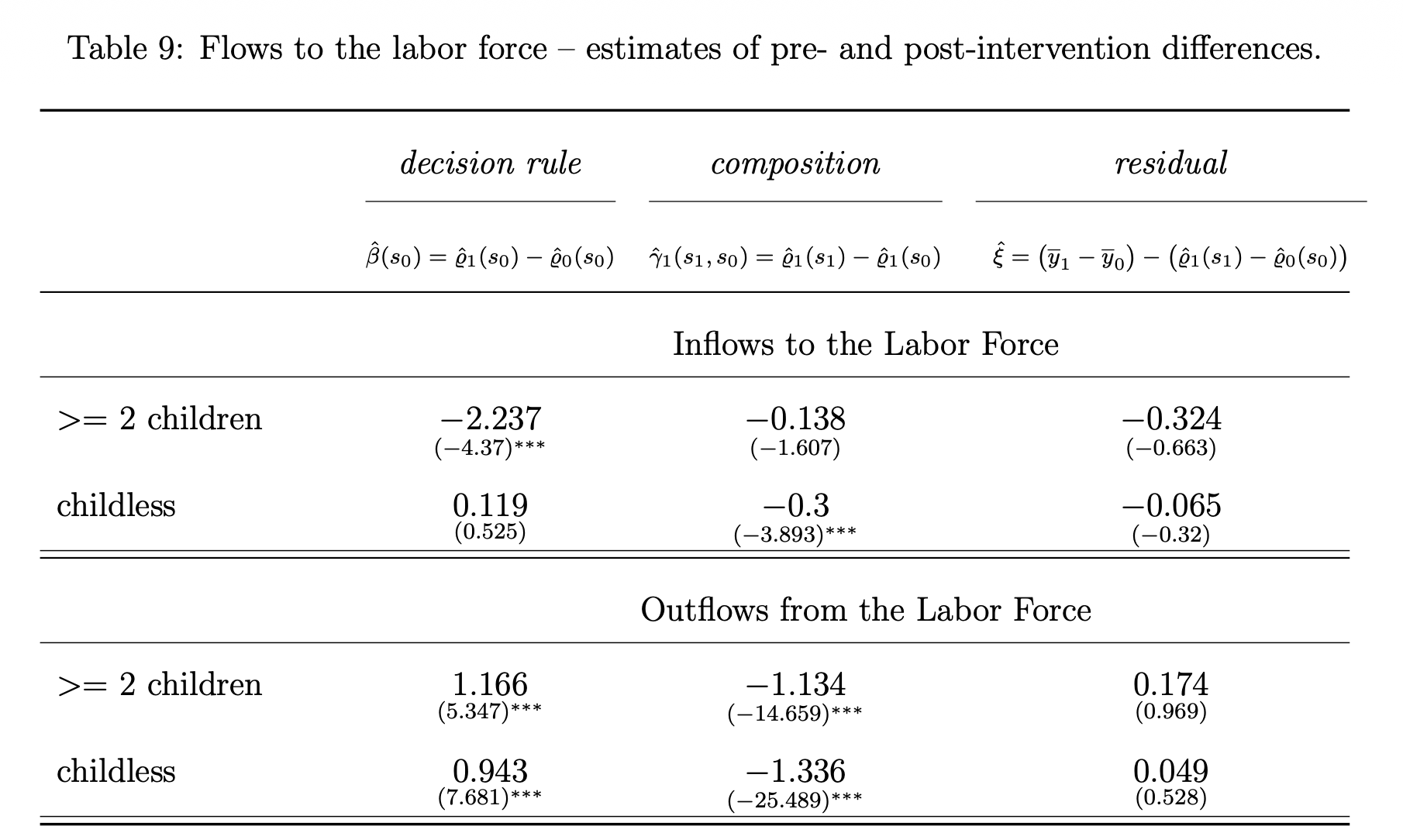
Abstract. This paper develops a structural approach to evaluating universal government programs where the lack of appropriate control groups limits the usability of traditional evaluation methods. We ground the analysis in a dynamic discrete choice model of women's labor force participation and search decisions in the presence of child benefits. The structural model generates conditional choice probabilities — the same objects that the Generalized Random Forest estimates non-parametrically from the data, conditioning on 379 observed state variables. This approach combines the causal interpretability of structural models with the flexibility of machine learning methods. We apply the framework to evaluate the effects of Poland's Family 500+ child benefit program on female labor supply. A structural model calibrated to the micro-data generates quantitative predictions — including policy experiments under alternative benefit designs and a welfare analysis — that validate the non-parametric estimates. The program reduced female labor force participation by 2–3 percentage points among eligible women, primarily through discouragement of labor force entry. Forward-looking behavior amplifies the effect fivefold relative to a myopic response, and the entry ATT exhibits strong diminishing returns to benefit generosity.

Homeownership as Rental Risk Insurance

with Hasan Cetin

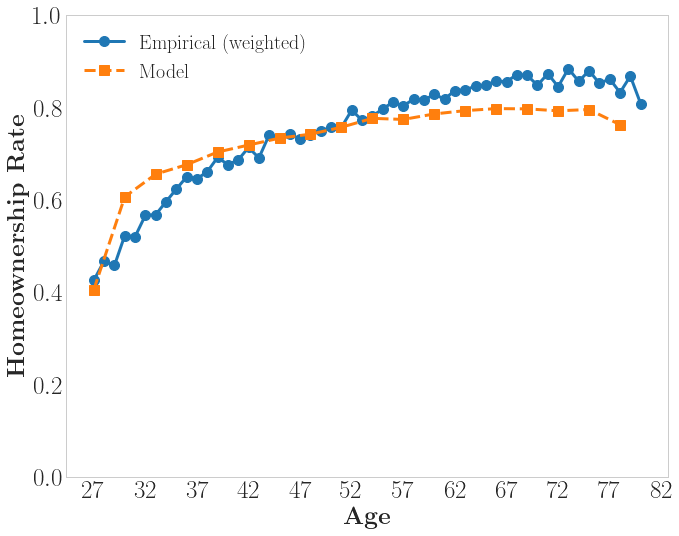
Abstract. Why do households choose to own rather than rent, even when ownership requires large upfront costs and long-term commitments? This paper proposes that homeownership serves as insurance against rental-price risk. Using panel data we document that rental risk rises with age. To quantify the implications of this risk, we develop a life-cycle model in which heterogeneous households choose between renting and owning under income, rent, and house price shocks, subject to borrowing constraints, moving costs, and bequest motives. Because of rental risk, the homeownership rate falls by 0.5 percentage points — indicating that the desire to self-insure against uninsurable rent shocks accounts for a significant share of observed ownership. The mechanism operates primarily through the extensive margin: higher rental volatility encourages transitions into ownership, especially for middle-aged households near the down-payment threshold. These findings highlight a previously underappreciated motive for homeownership and suggest that volatility in rental markets can have first-order effects on tenure decisions and welfare.

Migration Policy in a Spatial Equilibrium Model

with Sean Bassler

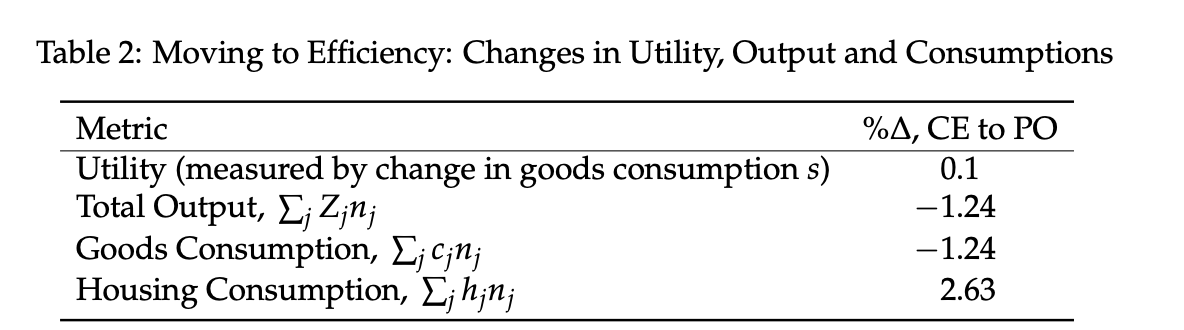
Abstract. Should we tax or subsidize migration to more productive but overcrowded cities? This paper investigates the efficiency of the Rosen–Roback model in a spatial equilibrium context with inelastic housing supply and a significant externality in housing markets. As workers move to the most productive cities to capitalize on higher wages, they inadvertently raise housing prices, imposing congestion costs on all residents. This negative externality leads to an inefficient allocation of labor, with too many workers concentrated in high-productivity, high-cost areas. We explore the optimal policy response and find that taxing labor in these congested cities and redistributing workers can improve overall welfare — the optimal labor tax increases welfare by 0.1%. Our calibrated model shows that correcting the externality raises housing consumption by 2.6% while reducing goods consumption and output by 1.2%, emphasizing the trade-offs between migration-driven economic gains and the cost of higher housing prices.